Concept Note
Introduction
In mid-September 2026, Türkiye’s intelligence chief Ibrahim Kalın and a Qatari national-security delegation led by Hamad bin Khamis Al-Kubaisi visited Kabul, with Kalın also travelling to Kandahar. They met the Taliban’s security core—Abdul Haq Wasiq, Sirajuddin Haqqani, Mohammad Yaqoob Mujahid, and Abdul Ghani Baradar. The agenda was not political settlement. It was intelligence cooperation, counter-narcotics, trafficking, terrorism, Afghanistan–Pakistan tensions, and closed trade routes. Afghanistan is once again being approached as a security file, not as a political community with rights and agency.
Rationale
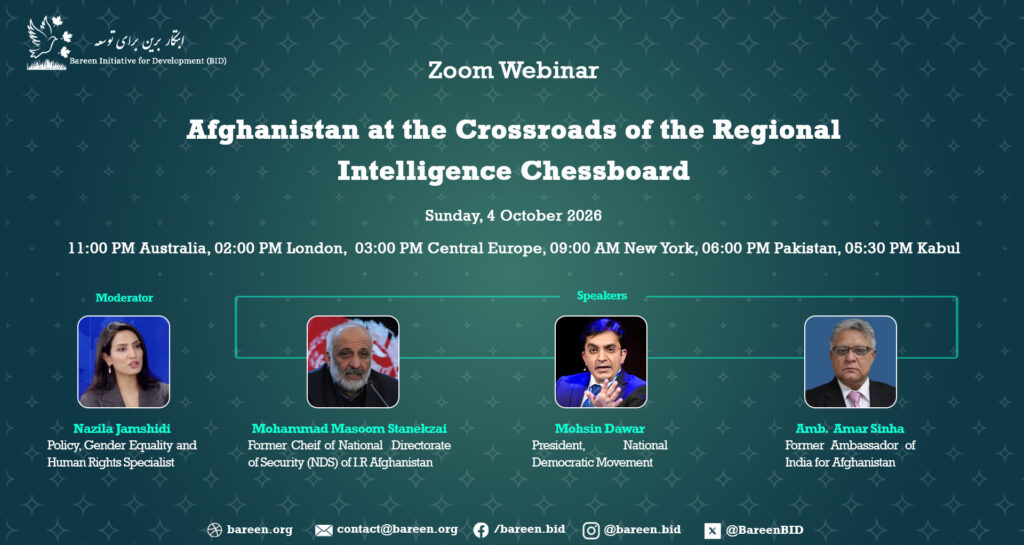
These visits confirm a regional shift: states are managing Afghanistan through intelligence channels rather than an inclusive political process. Ankara and Doha are positioning themselves as mediators between Kabul and Islamabad after failed earlier talks, border clashes, and collapsing transit. That may ease tactical pressure. It also risks normalising Taliban security elites as the only usable interlocutors while women, civic actors, and political alternatives remain outside the room. BID convenes this webinar to read the visits as part of a regional intelligence contest—and to ask what they mean for Afghanistan’s future, not only for short-term de-escalation.
Objective
➢ Analyse the Turkish and Qatari visits: who was met, what was discussed, and what was left off the table.
➢ Place Afghanistan on the regional intelligence chessboard, especially the Pakistan file and competing regional interests.
➢ Assess the cost of security-first engagement for legitimacy, rights, and Afghan agency.
➢ Identify future-oriented options that reconnect regional mediation to political inclusion and accountability.
Key Message
Intelligence diplomacy can reduce violence and reopen trade, but it cannot substitute for a political compact. If Afghanistan is treated only as a board on which Türkiye, Qatar, Pakistan, and other powers move pieces, the result will be managed instability: cooperation without recognition, quiet without rights, and deals without a people. The central question is whether Afghans remain the object of regional security bargains or become subjects of their own future.
Discussion Themes
➢ Theme 1 — Reading the visits: mediation or consolidation of a security order?
What did Ankara and Doha seek in Kabul and Kandahar? Why were intelligence and interior actors the main counterparts? Can a Turkish–Qatari channel freeze the Afghanistan–Pakistan conflict—TTP accusations, border war, and closed crossings—without addressing the deeper crisis of legitimacy inside Afghanistan?
➢ Theme 2 — After the chessboard: what future for Afghan agency?
If regional engagement continues through spy chiefs and Taliban security elites, who speaks for Afghan society? What red lines should be set so that de-escalation does not become quiet legitimisation? What role remains for civic actors, women, the diaspora, and a rights-based regional compact?
Expected Outcome
Participants will leave with a concise reading of the visits, a clearer distinction between tactical mediation and political progress, and a short set of recommendations for policymakers, media, and Afghan civic networks. BID will issue a post-webinar brief to support further advocacy
Format
➢ Duration: 2 hours, comprising a keynote address, a moderated panel discussion, and an interactive Q&A session.
➢ Platform: Conducted via Zoom, with live streaming on the Bareen Initiative for Development’s website and social media channels to ensure global accessibility.
➢ Moderation: Facilitated by senior experts from the Bareen Initiative for Development to ensure rigorous, inclusive, and constructive dialogue.
Call to Action
The Bareen Initiative for Development (BID) calls on stakeholders to engage in this critical dialogue to reassess past policies and chart a principled path forward for Afghanistan and the region. Through rigorous analysis, collaborative innovation, and a commitment to justice, this seminar aims to contribute to the creation of safer, more equitable, and resilient communities. Join us to shape a future that upholds both strategic imperatives and universal human rights.
Concept Note English