
Introduction:
On Saturday, December 6, 2025, the Bareen Initiative for Development (BID), in collaboration with the NRF Women’s Council and the Global Equality Association, held the fourth session of the Bareen Democracy Forum under the title “Gender Apartheid in Afghanistan: From the Streets of Kabul to the Global Digital Space.” The event was timed to coincide with the eve of the International Day for the Elimination of Violence against Women. According to United Nations statistics, at least one in three women worldwide more than 840 million women has experienced physical or sexual violence at least once in her lifetime. Yet the situation of women in Afghanistan is incomparably more dire. Since the Taliban returned to power in 2021, they have imposed severe and systematic restrictions, particularly on education, social participation, and political engagement, effectively turning the country into what many describe as “a total prison for girls and women.” Numerous experts now characterize this reality as widespread, systematic gender apartheid. This gender apartheid is no longer confined to physical borders; it has spread into the digital realm. Online harassment, digital threats and coordinated cyber operations against women activists, journalists and human-rights defenders both inside and outside the country were among the central issues discussed. The webinar aimed to foster dialogue, raise awareness, exchange ideas and identify practical solutions to amplify the voices of Afghan women who have been silenced inside the country.
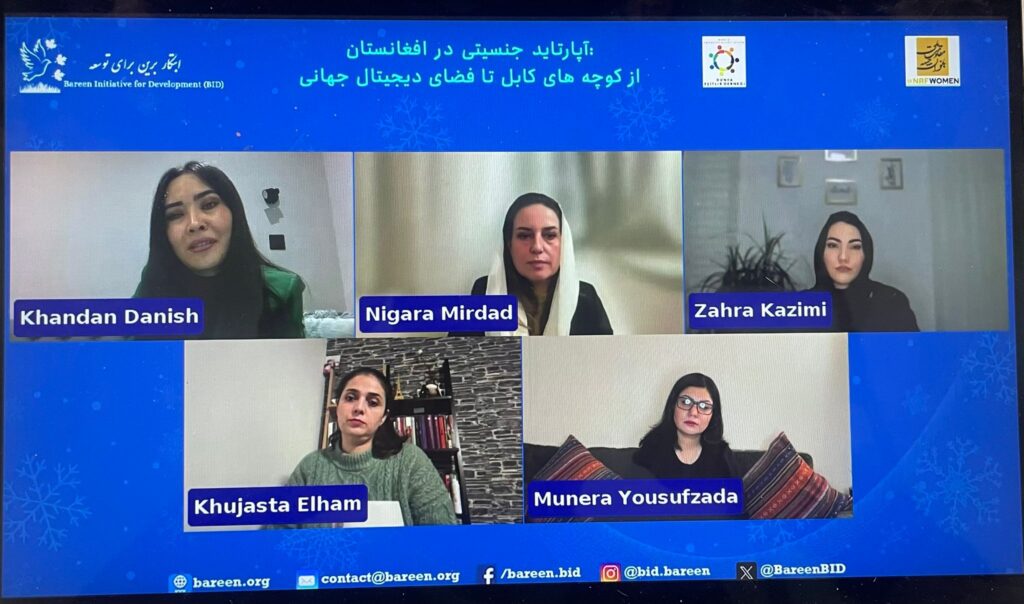
Event Details:
The program was organized as a webinar by the Bareen Initiative for Development (BID) in collaboration with the aforementioned organizations.
- Main objective: Promote dialogue and propose concrete measures to support Afghan women and girls in these dire circumstances.
- Platform: Leveraging the global campaign for the International Day for the Elimination of Violence against Women.
- Target audience: Women’s rights activists and those engaged in social and political issues.
Panel Discussion: Gender Apartheid in Afghanistan – Physical Dimensions and Cyber-Terrorism
The core discussion examined the multiple layers of gender apartheid: from the physical prohibitions imposed by the Taliban in homes and streets to the new forms of violence that seek to silence women’s voices on the global digital stage.
Speakers:
The panel featured distinguished guests actively working on women’s rights and socio-political issues:
- Mrs. Nigara Mirdad – Deputy Ambassador of the Islamic Republic of Afghanistan in Poland
- Ms. Munera Yousufzada – Former Deputy Minister of Defense of the Islamic Republic of Afghanistan
- Mrs. Zahra Kazimi – Political analyst and Chairperson of the NRF Women’s Council
- Mrs. Khujasta Elham – Poet, writer and expert in women’s studies
Key Points from the Speakers:
Mrs. Nigara Mirdad – Defining and Outlining Gender Apartheid
- Definition: Deliberate, systematic policies by the Taliban comparable to South African apartheid. She noted that the Taliban have issued more than 200 decrees aimed at erasing and restricting women.
- Difference from traditional apartheid: Certain Taliban restrictions (e.g., banning women from traveling alone) are, in her words, “even more barbaric” than those of the South African regime.
- Dimensions:
- Legal: Systematic deprivation of basic rights through decrees of the “Commander of the Faithful.”
- Economic: Removal of women from government, private and international institutions, leading to long-term economic collapse and poverty.
- Social/psychological: Women are excluded not only from society but even from family decision-making; these restrictions have become normalized in some households. She stressed the urgent future need for psychological support for Afghan women.
Mrs. Zahra Kazimi – Institutionalized Violence and Cyber-Terrorism
- Institutionalization of violence: Violence against women has moved beyond individual acts to become collective, systematic and culturally entrenched. The Taliban treat women as second-class beings or mere objects.
- Digital violence: The online space—the last remaining refuge for many women—has turned into a battlefield of coordinated harassment and unethical use of images to silence them.
- Taliban narrative-building: The group uses digital platforms to propagandize and “normalize” their misogynistic laws, publishing fabricated images to portray the situation as ordinary and gain legitimacy.
- Consequences: She cited the tragic suicide of a young woman after relentless online attacks and threats following her right to education, as well as rising suicide rates among young women and increased domestic violence due to the Taliban’s patriarchal laws.
Ms. Munira Yousufzada – Roots and Nature of Online Violence
- A modern form of violence: She described digital violence as a “new, modern” type that has tripled after the Taliban’s return, especially targeting activists and journalists.
- Reasons for societal vulnerability:
- Deeply rooted patriarchal culture based on distorted religious interpretations that view women’s freedom as a threat to men.
- Lack of media literacy, where “freedom of expression” is mistaken for “freedom to insult,” turning social media into a safe arena for psychological abuse.
- Taliban cyber army: She described online violence against Afghan women as part of a highly organized systematic campaign run by the Taliban’s “cyber army” to silence activists.
Mrs. Khujasta Elham
- Systematic gender apartheid: Complete removal of women from rights, economy and society—an organized system of repression.
- Cyber-terrorism against women: Repression has migrated online through harassment and threats carried out by the Taliban’s “cyber army” to mute activists.
- Normalization of violence: The Taliban exploit propaganda and entrenched patriarchal culture to legitimize their misogynistic policies.
- Proposed strategy: Unity and documentation—building strong internal solidarity and rigorously documenting abuses so that gender apartheid can be formally recognized internationally.
Proposed Strategies to Confront Gender Apartheid:
The panellists offered the following actionable recommendations:
- Documentation and counter-narrative: Systematically collect evidence and local testimonies from inside Afghanistan and present them to international bodies to challenge the Taliban’s narrative and achieve global recognition of gender apartheid.
- Internal unity and broad consensus: Create a large-scale coalition of all women’s rights activists for a coordinated struggle; lack of unity has allowed the apartheid to persist.
- Public awareness and internal resistance: Raise awareness inside Afghanistan to shift public opinion, and educate women to recognize and resist misogynistic behavior within families and prevent the normalization of restrictions.
- Defining cyber-terrorism: Taliban online violence, especially against women activists, should be formally classified as “cyber-terrorism,” and digital tools should be deployed to counter it.
Conclusion: The Need for Cohesive, Multi-Dimensional Action.
The webinar made clear that the situation of women in Afghanistan is no longer a temporary human-rights crisis; it is systematic gender apartheid institutionalized by a deeply misogynistic regime. This repression has crossed physical borders and now continues in the form of cyber-terrorism in the digital world. Effective resistance requires coordinated, multi-faceted action centered on rigorous documentation of abuses, forging nationwide solidarity among activists, and awareness-raising at family and community levels. Success in dismantling gender apartheid depends on challenging the Taliban’s narrative globally while supporting resistance inside the country.
Concept Note English
Concept Note Persian
English Report:
Persian Report: