Introduction
Pakistan’s foreign and security policy toward the Taliban has been one of the most complex and contentious issues in South Asian regional dynamics. Once recognized as a key supporter of the Taliban in past decades, Pakistan has recently shown signs of a significant policy shift, moving toward opposition to the group. This strategic pivot, shaped by domestic, regional, and international factors, carries profound implications for regional security, Pakistan’s relations with its neighbors—particularly Afghanistan—and its standing in the global order. The seminar titled “Pakistan’s Geopolitical Pivot: From Supporting the Taliban to Strategic Confrontation?” provides a platform to explore these transformations, analyze the drivers behind this shift, and assess its impact on the region’s future.
Key Discussion Themes:
- Historical Roots of Pakistan’s Support for the Taliban
- Analyze the Drivers of Pakistan’s Policy Shift
- Strategic and Regional Implications
- Propose Policy Recommendations
Speakers
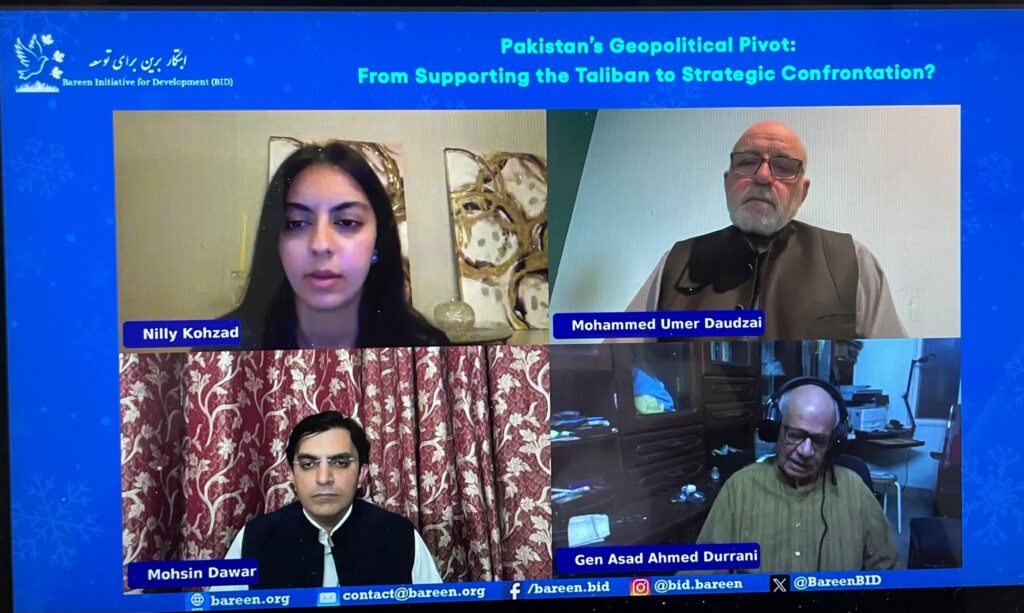
The panel featured distinguished speakers, including Mr. Mohsin Dawar, Mr. Mohammed Umer Daudzai and Mr. Asad Durrani, each offering unique perspectives on the issue:
Analysis of Speakers’ Content: Perspectives and Approaches
Mr. Mohsin Dawar
- A deliberate mindset and motivation was established in Khyber Pakhtunkhwa, brainwashed through media, movies, school curriculum creating an environment towards war and jihad in Afghanistan
- Militants from around the world were brought to the Pashtun areas, blaming the locals
- Pakistan has always played the role as a local contractor to the US, facilitating the Taliban takeover, Pakistan wants hegemony in the region through this controlled project
- Followed by the Doha deal, Afghanistan’s republic was de-recognized and the US wanted this region to be used against China’s economic expansion
- Afghan Taliban and TTP are two sides of the same coin
- Pakistan does not have a serious will to stop extremism, terrorism
- Pakistan’s aerial attack in Kabul was unprecedented, only possible because Taliban do not have legitimacy
Mr. Mohammed Umer Daudzai
- Afghanistan actually used Pakistan as its “Strategic Depth” until the collapse of the Soviet Union where things shifted
- Pakistan’s nuclear status made Strategic Depth a useless policy and instead “Strategic Bridging” became the new doctrine, where Afghanistan was a bridge to Central Asia
- Win-win situation and trust building for a common framework between Afghanistan and Pakistan is possible, has been established in the past but Doha deal scrapped everything
- Doha deal was a regional game, including Iran and Russia
- The cost in blood and dollars in supporting the Taliban was low, cheaper for the US and easier to safeguard American interests
- Mistrust between Pakistan and Afghanistan have been on the Durand line and Kabul’s ties with India but people to people relations are fine
- Taliban are a danger and risk to humanity
Gen Asad Durrani
- Historically, Pakistan’s role has always been to support resistance to foreign occupation, including the US and Soviet Union
- Strategic Depth was a one-man policy
- Pakistan created friction on both sides of its border, with India and Afghanistan
- Pashtuns are at the crossfire of conflict not by design but by geography, being at the juncture of powers
- US and Pakistan relations are currently not good, but both stand with differences in world views
- Pakistan would not support US footprint in Afghanistan again, in Bagram’s case
Proposed Strategies and Conclusion
- Free cross-border travel and trade should be implemented between Afghanistan and Pakistan – similar to Germany and France.
- Regime change does not give positive change, rather, leadership change is needed. If leadership is changed then the region can start engagement, under conditions and reforms accepted by Afghans in this stage.
- Both sides must have legitimate governments that stand with people’s support in order to cooperate in a Loya Jirga joint session agreeing on a solution to work together.
Concept Note English
Concept Note Persain
English Report
Persian Report