
Introduction: A Spark of Hope
On Saturday, July 12, 2025, a significant event titled “From the Shadow of Taliban Lobbying to the Mosaic of Peace: Reimagining a Post-Taliban Future” was organized by the Bareen Initiative for Development (BID). The gathering brought together diplomats, analysts, civil society activists, women’s rights advocates, and youth to discuss three key themes: the Taliban’s performance on the international stage, a critique of the United Nations’ “Mosaic” plan, and visions for Afghanistan’s future beyond Taliban rule. This event, held amidst the darkness enveloping Afghanistan, served as a spark of hope—a platform for exchanging solutions, garnering global legitimacy for the people’s resistance, and emphasizing the need to restore a system rooted in justice, participation, and human rights. Its goal was to forge a more cohesive and effective discourse from the crisis, one capable of representing the will of the Afghan people in shaping their destiny.
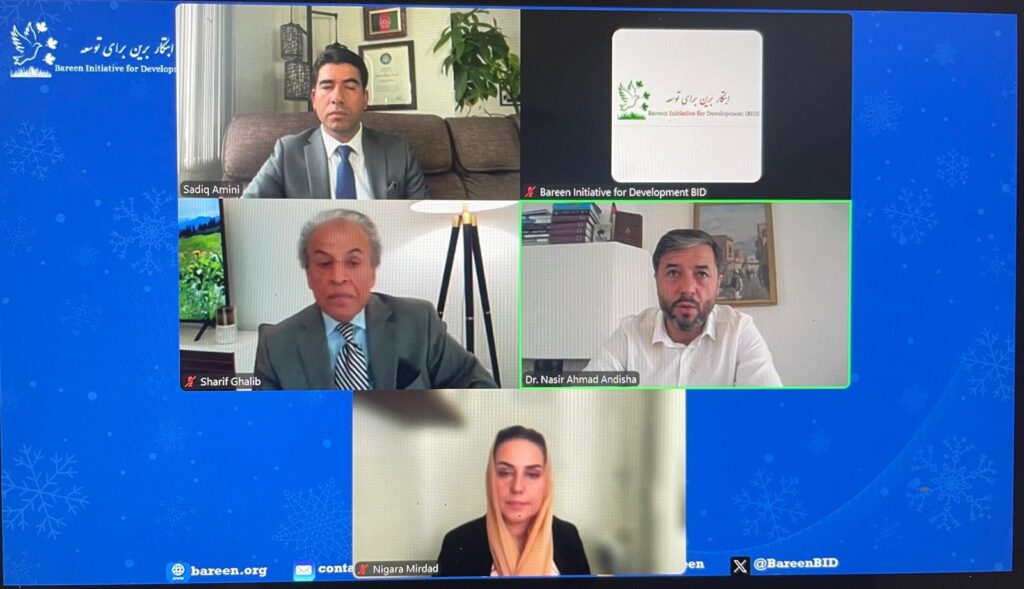
Program Details: The Mosaic of Peace in a Post-Taliban Future
Organized as an international webinar by the Bareen Initiative for Development (BID), the event aimed to reimagine Afghanistan’s future amid post-Taliban transformations. It provided a platform for multilayered dialogue on the Taliban’s political lobbying, its implications for Afghan politics and society, and alternative visions for peace, justice, and social reconstruction. The cross-border conversation among lived-experience experts, analysts, and activists lent the event a comprehensive and interactive dimension. The program went beyond mere political analysis, focusing on political, human, cultural, and social dimensions of transitioning from Taliban rule. It highlighted themes of identity, meaning, hope, and the restoration of social trust. This collective dialogue demonstrated that Afghanistan’s future lies not in passivity or acceptance of the status quo but in awareness, solidarity, and the reimagining of peaceful narratives. From these efforts emerged a vision of a “mosaic of peace”: diverse, multi-voiced, and humane.
Panel Discussion: Political Outlook for a Post-Taliban Afghanistan
In this segment, three diplomats and analysts with complementary perspectives examined Afghanistan’s current state and future prospects:
- Mr. Sadiq Amini, Founder of Afghanistan Impact
With mastery of the subject, an insightful presentation style, and measured facilitation, Mr. Amini guided the discussion to ensure intellectual engagement, mutual respect, and content focus. By posing key, targeted questions, he elevated the discourse beyond mere analysis toward strategic insights and actionable proposals. - Dr. Nasir Ahmad Andisha, Ambassador and Permanent Representative of Afghanistan in Geneva
Dr. Andisha highlighted the dangers of unconditional international engagement with the Taliban, calling for the legitimization of popular resistance and the disruption of the Taliban’s financial resources. - Mrs. Nigarah Mirdad, Deputy Ambassador of Afghanistan in Poland
Mrs. Mirdad critiqued the UN’s “Mosaic” plan and proposed establishing a political office for Taliban opponents to consolidate efforts and represent the Afghan people’s voice. - Mr. Sharif Ghalib, Former Policy Advisor at the Ministry of Foreign Affairs
With an analytical perspective, Mr. Ghalib stressed the need to reassess the Republic’s experience and establish a participatory, rule-based system while calling for an end to foreign support for the Taliban.
Key Discussion Topics: From the Collapse of Lobbying to a Call for Peace New Voices for the Future
The event focused on three main themes, with the following key outcomes:
- The Taliban’s lobbying efforts at international, regional, and domestic levels have weakened and lack their former support.
- Russia’s recognition of the Taliban was deemed an isolated and risky move, lacking regional consensus.
- Afghan diplomats in exile must form a cohesive structure to represent the people.
- The UN’s Mosaic plan was criticized as ineffective for ignoring the demands of the Afghan people, particularly women.
- Proposed solutions include forming a unified political front, targeted international pressure, and genuine intra-Afghan dialogue.
Russia’s Recognition of the Taliban: Tactic or Strategy?
Dr. Andisha and Mr. Ghalib viewed Russia’s recognition of the Taliban as a hasty, unilateral decision lacking regional consensus, potentially harmful to both Russia and the Taliban. Concerns were raised about its implications for counterterrorism efforts and the strengthening of the Taliban’s military capacity. Diplomacy and the Role of Afghan Diplomats
Mrs. NIgarah Mirdad and others emphasized the critical role of Afghan diplomats abroad. They proposed creating a cohesive political representation for Afghans in exile to counter Taliban lobbying and provide a credible voice for the Afghan people. Critique of the UN’s Mosaic Plan
The UN’s Mosaic plan faced strong criticism for its lack of genuine Afghan participation and its disregard for widespread human rights violations by the Taliban, particularly against women. It was also seen as conflicting with UN Security Council Resolution 2721. Conclusion
Participants agreed that the Taliban’s lobbying has lost its former influence, the Mosaic plan is ineffective, and the only long-term solution for Afghanistan lies in a national consensus and an inclusive political framework.
Proposed Strategies and Final Recommendations
- Establishing a Cohesive Political Platform: A key proposal was to create a political platform or coordinating office for anti-Taliban forces to serve as a unified voice for the opposition and resistance in engaging with the international community.
- Legitimizing the Fight Against the Taliban: Speakers emphasized the need to recognize the legitimacy of political, civil, and military resistance. Without this, the struggle against the Taliban risks being undermined.
- Strengthening International Support: Democratic nations were urged to align their positions, increase political, media, and legal support for Afghans, halt the Taliban’s financial resources, and condition any engagement with the group.
- Facilitating Intra-Afghan Dialogue: For sustainable peace, the final solution must be crafted by Afghans, with participation from all groups, including women, youth, and civil society. A reimagined governance structure based on genuine representation is essential.
- Promoting Regional Convergence: Afghanistan must move beyond geopolitical rivalries and leverage cooperation with key regional players like India, Russia, and China to secure its role in transit, trade, and peacebuilding.
- Highlighting the Leading Role of Women and Youth: Speakers underscored the pivotal role of women, particularly in civil resistance, recognizing them as trailblazers in the path to freedom.
Concept Note English
Concept Note Persian
English Report
Persian Report