
Concept Note
Introduction
The Matilda Effect, named in honour of Matilda Joslyn Gage, refers not only to the historical overlooking or appropriation of women’s achievements in science and knowledge but also to a broader, systematic pattern of silencing women’s voices and erasing their contributions across public, political, social, and cultural spheres. More than four years into the Taliban’s renewed rule, Afghanistan stands as the only country in the world where girls are systematically barred from secondary and higher education, and women are excluded from many workplaces, social spaces, and even the right to be heard in public. Today, under Taliban governance, the Matilda Effect manifests in an extreme and institutionalized form: not merely the denial of accomplishments, but the deliberate erasure, restriction, and punishment of women’s fundamental rights, presence, and social existence. International Women’s Day offers a vital opportunity to highlight this harsh reality while underscoring that silence in the face of such gender apartheid is itself part of the same historical mechanism of denial.
Rationale:
- Over 2.2 million girls remain deprived of education (based on UN and UNICEF reports through the end of 2025).
- New restrictions in 2025 and early 2026 include bans on books authored by women, prohibitions on women’s voices in recitation or singing, raids on women’s workplaces, and expanded exclusions from international and humanitarian organizations.
- These policies constitute not only grave human rights violations but also a direct threat to Afghanistan’s sustainable development, poverty reduction, public health, and socio-economic stability.
- International Women’s Day 2026 provides a powerful symbolic moment for the international community and women’s rights advocates to spotlight this structural denial once again—and to demonstrate that combating the Matilda Effect in the 21st century extends far beyond scientific credit; it is now a matter of women’s survival and human dignity.
Objectives:
- Recontextualize the Matilda Effect within contemporary gender apartheid—illustrating the historical continuity of women’s erasure from the 19th century to the Taliban’s policies in 2026.
- Amplify Afghan women’s voices—creating a space (even virtual or symbolic) for the stories of women and girls directly impacted by these restrictions to be heard.
- Raise awareness and exert diplomatic pressure—calling on the global community to formally adopt the term “gender apartheid” and pursue international legal mechanisms against these policies.
- Strengthen transnational solidarity—showing that the fight for women’s rights is a global one, and the denial of women in one country threatens human rights values everywhere.
- Highlight civil and creative resistance—showcasing examples of Afghan women’s resilience, from clandestine education to underground and artistic activities.
Expected Outcomes
- Produce multilingual content (text, video, infographics) in at least five major languages (Dari, Pashto, English, Arabic) with a target of at least 200,000 organic views/engagements.
- Launch at least one joint statement or campaign involving human rights organizations, women’s groups, and prominent international figures, centered on “The Matilda Effect in Afghanistan.”
- Increase media and social media coverage of Afghan women’s situation internationally (using suggested hashtags: #MatildaEffectAfghanistan #EndGenderApartheid).
- Document 10–15 direct narratives from Afghan women and girls (with full attention to safety and anonymity) for future reports and advocacy.
- Strengthen networks connecting Afghan women activists inside and outside the country for sustained support.
Discussion Themes
- The Continuity of Women’s Erasure – From the Matilda Effect to Gender Apartheid in Afghanistan 2026
Tracing the historical progression from the historical erasure of women’s credit and achievements (the Matilda Effect) to the systematic denial of their voices, presence, and fundamental rights under the Taliban: the ban on education for over 2.2 million girls, the removal of books written by women from universities, the prohibition of women’s voices in recitation and singing, and the transformation of denial into institutionalized, legal gender apartheid.
Key question: How has historical denial of women evolved into the complete erasure of their social existence in Afghanistan today? - Afghan Women’s Resistance and Global Advocacy Against Gender Apartheid
Highlighting creative forms of resistance by Afghan women (clandestine education, underground activities, art, and digital efforts) and the urgent need for international pressure: official use of the term “gender apartheid,” pursuit of global legal mechanisms, amplification of Afghan women’s voices, and transnational solidarity to end this structural denial.
Key question: How can Afghan women’s resistance be channelled into worldwide pressure to recognize gender apartheid as a crime against humanity?
Key Message
The Matilda Effect in Afghanistan is no longer just a historical term; it is an active, ongoing policy that stifles women’s voices, bans their presence, and darkens their future. We honour the memory of Matilda Joslyn Gage while raising our voices: as long as an Afghan girl is denied school because of her gender, as long as an Afghan woman’s voice is treated as a crime, none of us can truly be free.
Format
- Duration: 2 hours, comprising a keynote address, a moderated panel discussion, and an interactive Q&A session.
- Platform: Conducted via Zoom, with live streaming on the Bareen Initiative for Development’s website and social media channels to ensure global accessibility.
- Moderation: Facilitated by senior experts from the Bareen Initiative for Development to ensure rigorous, inclusive, and constructive dialogue.
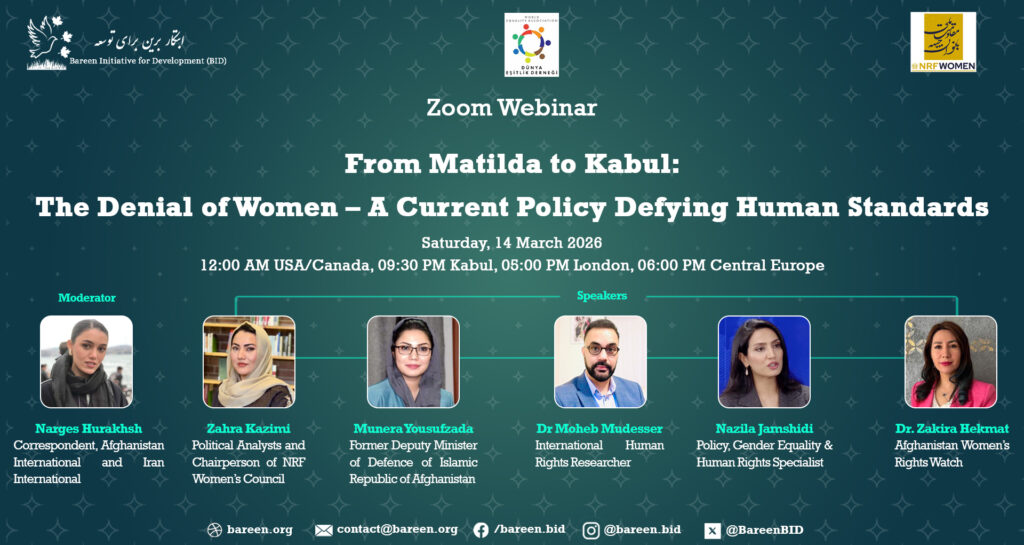
Date & Time: 14 March 2026, 05:00 Pm London Time Zone, 12:00 Pm USA Time Zone, 06:00 pm Europe time zone, 08:00 Pm Turkey time zone
Moderator: Narges Hurakhsh, Correspondent at Afghanistan International and Iran International
Speakers:
Ms. Nazila Jamshidi, Policy, Gender Equality & Human Rights Specialist
Mrs. Zahra Kazimi, Political analysts & chairperson of NRF women’s council
Munera Yousufzada, Former Deputy Minister of Defence of Islamic Republic of Afghanistan
Dr Moheb Mudesser, International Human Rights Researcher
Dr. Zakira Hekmat, Afghanistan women’s rights watch
Call to Action
The Bareen Initiative for Development (BID) calls on stakeholders to engage in this critical dialogue to reassess past policies and chart a principled path forward for Afghanistan and the region. Through rigorous analysis, collaborative innovation, and a commitment to justice, this webinar aims to contribute to the creation of safer, more equitable, and resilient communities. Join us to shape a future that upholds both strategic imperatives and universal human rights.