
Introduction
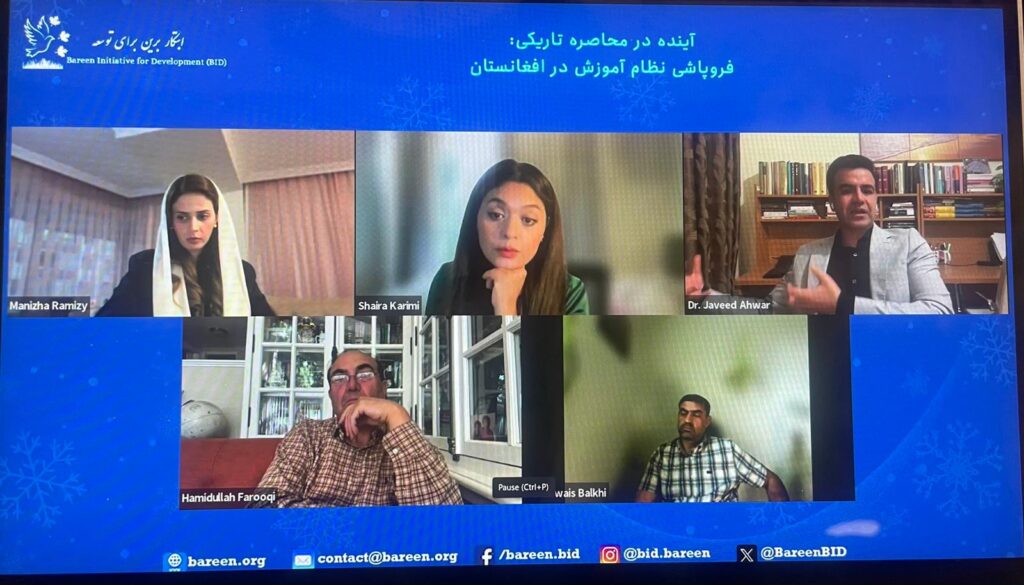
The education system, as the backbone of societal development, plays a pivotal role in empowering individuals, alleviating poverty, fostering social cohesion, and driving economic progress. In Afghanistan, following the year 2001, the education system witnessed remarkable progress with substantial international support. However, the Taliban’s return to power in August 2021 and their restrictive policies particularly the ban on girls’ education beyond the sixth grade and changes to the curriculum have pushed the system to the brink of collapse. This online seminar aims to explore the multifaceted dimensions of this crisis, analyze its consequences, and propose actionable solutions for the future.
Background and Rationale
Between 2001 and 2021, Afghanistan’s education system achieved significant milestones with the support of the international community, including financial and technical assistance. Notable progress included increased access to education, particularly for girls, and the development of educational infrastructure. However, the Taliban’s resurgence and their imposition of stringent policies—such as prohibiting girls’ education beyond the sixth grade and shifting the curriculum toward exclusively religious content—have steered the education system toward collapse. These changes not only contradict global standards for modern education but also fail to address Afghanistan’s future needs. This seminar seeks to provide an in-depth analysis of these issues, examine the long-term consequences of the education system’s collapse, review past achievements and challenges, and assess the political, social, legal, and economic ramifications of this crisis. Furthermore, it aims to foster a specialized discourse to draw the attention of the international community and domestic stakeholders to the urgent need for reconstructing a modern and inclusive education system.
Seminar Objectives
- Analyze the Long-Term Consequences of the Education System’s Collapse: Examine the impact of educational restrictions, particularly on girls, on social, economic, and human development in Afghanistan.
- Review the History and Achievements of the Education System (2001–2021): Evaluate the progress made in education following the Taliban’s fall in 2001 and the role of international support in these achievements.
- Assess Political, Social, Legal, and Economic Implications: Analyze the effects of dismantling modern education on political stability, social cohesion, human rights compliance, and economic development.
- Propose Practical Solutions: Offer policies and strategies for rebuilding an education system aligned with modern needs and global standards.
Discussion Themes and Seminar Structure
- Long-Term Consequences of the Education System’s Collapse:
- Exacerbation of poverty cycles, increased early marriages, and child labor due to lack of education.
- Reduced female participation in social and economic development and its impact on GDP.
- Risk of raising a generation with limited perspectives and inability to compete in the global market.
- History of the Education System and International Support (2001–2021):
- Reconstruction of the education system post-2001 with international financial and technical aid.
- Increased access to education, particularly for girls, and the establishment of thousands of schools and universities.
- Persistent challenges, including shortages of female teachers and educational infrastructure in rural areas.
- Political, Social, Legal, and Economic Implications of the Collapse:
- Political: Diminished international legitimacy for the Taliban due to human rights violations and non-compliance with global commitments.
- Social: Widening gender disparities, weakened social cohesion, and the rise of extremist ideologies.
- Legal: Violations of international conventions, such as the Convention on the Rights of the Child and the International Covenant on Economic, Social and Cultural Rights.
- Economic: Loss of skilled human capital, Bareen drain, and worsening economic crises.
- Critique of the Taliban’s Curriculum:
- Elimination of core sciences and replacement with religious subjects, rendering the curriculum incapable of meeting modern societal needs.
- Misalignment with global educational standards and its implications for the future of Afghanistan’s youth.
Format
- Duration: 2 hours, including a keynote address, panel discussion, and Q&A session.
- Platform: Zoom, with live streaming on the Bareen Initiative for Development’s website and social media channels.
- Moderation: Facilitated by experts from the Bareen Initiative for Development (BID) to ensure an inclusive and constructive dialogue.
Expected Outcomes
- Increased Global and Public Awareness: Highlight the education crisis in Afghanistan and the urgent need for action.
- Comprehensive Analysis: Generate specialized knowledge on the consequences of the education system’s collapse and its impact on Afghanistan’s future.
- Policy Recommendations: Formulate practical strategies for reconstructing an education system emphasizing gender equality and modern education.
- Strengthened International Pressure: Encourage global institutions to exert diplomatic and economic pressure on the Taliban to restore the right to education.
Key Message
The collapse of Afghanistan’s education system not only jeopardizes the future of the country’s youth but also threatens regional political stability, social cohesion, and economic development. The Taliban’s current curriculum, with its unilateral focus on religious education and the exclusion of girls from schooling, cannot meet the modern needs of Afghan society. The international community, civil society, and Afghanistan’s intellectual elite must unite to rebuild an inclusive, modern, and equitable education system to secure a brighter future for the country.
Target Audience
- International policymakers and diplomats
- Non-governmental organizations and human rights institutions
- Researchers, academics, and education activists
- Civil society and the Afghan diaspora
- Media and the general public
Call to Action
The Bareen Initiative for Development (BID) invites stakeholders to participate in this critical dialogue to garner global support for rescuing Afghanistan’s education system. This program represents a step toward restoring hope and building a brighter future for the country’s next generations. Through collaboration and innovation, this seminar will contribute to creating safer and more cohesive communities.
English Report
Persian Report